 Quran

A long-term Hifz goal becomes more manageable when the timeline matches everyday responsibilities. For British Muslims balancing work, university, family, and masjid commitments, how to memorise the Quran in 2 years requires consistency without an unsustainable daily workload.
A two-year programme offers a structured middle ground between shorter, more demanding plans and slower timelines. With a clear schedule built around 730 days, learners can maintain steady progress while accommodating real-life interruptions.
1. Calculate Your Exact 2-Year Hifz Numbers Before Anything Else
Before memorising a single verse, you must understand the mathematics of your specific timeline. To memorise the Quran in 2 Years is fundamentally different from any other Hifz plan.
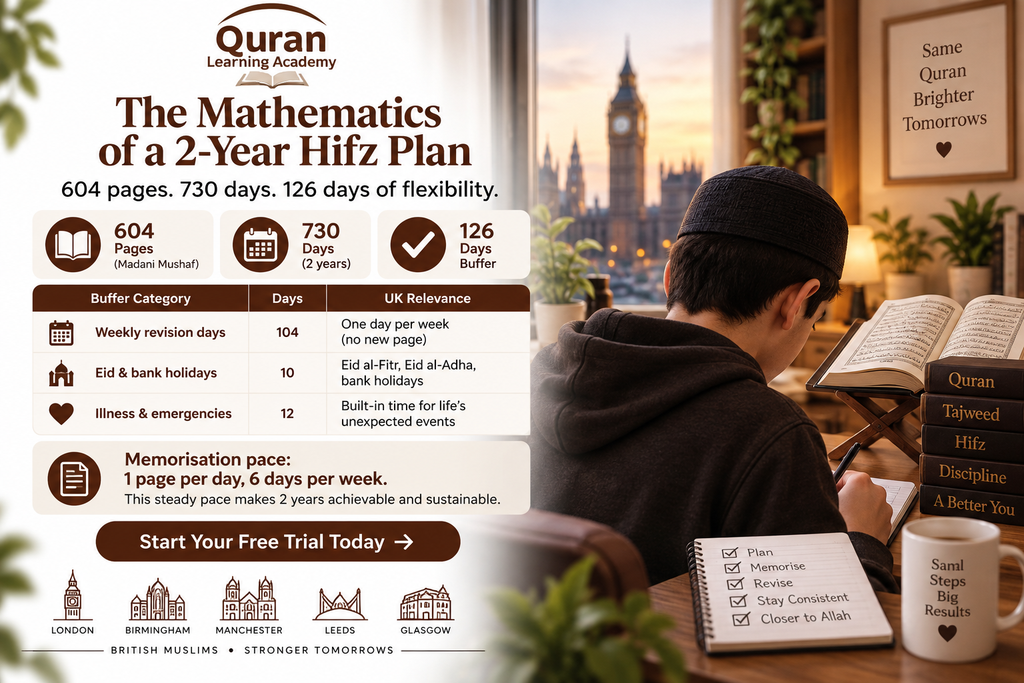
The standard Madani Mushaf contains 604 pages. A 2-year plan gives you 730 days. The gap between those two numbers, 126 days, is the structural advantage that makes this timeline work for British Muslims. A 1-year plan has zero buffer. A 2-year plan gives you 126 days of real, usable flexibility:
| Buffer Category | Days Allocated | UK Relevance |
| Weekly revision-only days | 104 days | One day per week: no new page, revision only |
| Eid and UK bank holidays | 10 days | Eid al-Fitr, Eid al-Adha, bank holiday weekends |
| Illness and family emergencies | 12 days | Two built-in weeks for disruptions |
Your memorisation pace is 1 page per day, 6 days per week. Not 2 pages. Not 1.5. Exactly 1 page. Anyone attempting a 1-year plan memorises double this pace with zero buffer. Anyone on a 3-year plan memorises at two-thirds this pace but risks losing urgency entirely. The 1-page-per-day pace is the number that makes 2 years work, and it must remain fixed throughout.
2. Establish Your Foundation Before Day One of Memorisation
The 2-year plan begins before you memorise a single page. Skipping this step is why many students reach month three and discover they are memorising incorrectly and must restart.
Three foundations must be in place before your first memorisation session:
- Fluent recitation: You must be able to read any page of the Quran smoothly before memorising it. Memorising with a choppy recitation embeds mistakes that take ten times longer to correct than to prevent.
- A single fixed Mushaf: Choose one print and never change it. The brain builds visual memory of exactly where a verse sits on a page. The 15-line Madani Mushaf is the standard for most UK Hifz students. Switching mid-plan breaks that visual memory entirely.
- A fixed daily time slot: The hour after Fajr is the most effective time for memorisation in terms of mental clarity. For UK Muslims working full-time, this may mean waking 45 minutes earlier than usual. The slot must be non-negotiable.
Allah affirmed that His book is structured to be retained by those who approach it with sincerity and preparation:
“وَلَقَدْ يَسَّرْنَا الْقُرْآنَ لِلذِّكْرِ فَهَلْ مِن مُّدَّكِرٍ “
Wa laqad yassarnal-Qur’āna lidhdhikri fahal min muddakir.
“And We have certainly made the Qur’an easy for remembrance, so is there any who will remember?”
Students whose recitation needs strengthening before beginning memorisation can build that foundation through the Noorani Qaida Course in the UK at UK Quran Learning Academy, which develops the phonetic accuracy every Hifz student requires before their first page.

Enrol in the Noorani Qaida Course
3. Structure Your Daily Routine Around Three Fixed Blocks
The daily routine for a 2-year plan requires 2 focused hours. A 1-year plan requires 3 to 4 hours daily. A 3-year plan can function on 1 hour. The 2-year plan sits at exactly 2 hours, divided into three blocks with a distinct purpose for each:
Teacher Session: 45 minutes
Recite to a qualified Quran teacher who corrects your Tajweed in real time. This block is structured as follows:
- 15 minutes: recite your newly memorised page to the teacher.
- 15 minutes: recite the pages memorised over the last 5 to 7 days.
- 15 minutes: recite a section of your older memorisation.
Memorisation Session: 45 minutes
Divide the new page into three sections: top, middle, and bottom. Repeat each line 10 to 15 times while looking, then recite without looking. Do not move to the next line until the previous one is solid without any prompting.
Deep Revision: 30 minutes
Spend this block on 5 to 10 pages of older memorisation. This converts short-term memory into permanent retention. Skipping this block is the single most common reason 2-year plans collapse at the halfway point.
UK adults managing full-time work can split these blocks across the day: Block 1 with an online teacher after Fajr, Block 2 during a lunch break, and Block 3 before Isha. The blocks do not need to be consecutive. They need to be daily without exception.
Students who want their teacher sessions to cover Tajweed correction and recitation accuracy simultaneously can enrol in the Online Tajweed Classes in the UK at UK Quran Learning Academy, which structures recitation correction into every live session.

Enrol in the Online Tajweed Classes
4. Apply the Three-Layer Revision System Every Single Day
The revision system for a 2-year plan is different from a 1-year or 3-year plan because the volume of memorised material at any point is unique to this timeline.
By month 12, a 2-year student has memorised approximately 180 pages. The revision load at that point is manageable if, and only if, all three layers are applied consistently every day:
- New lesson: 1 page per day, memorised in Block 2.
- Recent revision: The last 5 to 7 pages memorised, reviewed every day before beginning the new page. This prevents fresh memory from evaporating within a week.
- Cumulative revision: A rotating section of everything memorised more than one month ago, reviewed during Block 3.
Students who focus only on the new page and ignore the other two layers reach the end of the Quran and find that the beginning has been forgotten entirely.
This is the most common reason students must restart their Hifz from the beginning after months of effort.
The 126 buffer days built into the 2-year plan exist partly to give you recovery time when the revision load temporarily becomes too heavy during disrupted weeks.
Step Inside Our Virtual Classrooms
See how our interactive lessons work. Watch these brief highlights of our students engaging with instructors.
Start Your Quranic Journey in the UK
Join our academy for structured online lessons with expert tutors, tailored to fit your schedule.
Book Your Free Trial5. Use the Night Before to Prepare the Following Day’s Page
One technique that is specific and essential to the 2-year pace is night-before preparation. At this rate, you have exactly one day per page. You cannot afford to spend your morning session hearing a page for the first time while also attempting to memorise it.

The night before each new page, spend 15 minutes doing the following:
- Listen to the page being recited by a proficient reciter. Hearing the page before memorising it primes the brain to recognise the sounds the following morning.
- Read the page once slowly without attempting to memorise it. Familiarity with the page reduces the morning session time by a significant margin.
- Read a brief explanation of the verses being memorised. Understanding what you are memorising, even at a basic level, creates meaning-based memory anchors that are significantly more durable than sound-based memory alone.
This 15-minute preparation the night before is the difference between spending 45 minutes the next morning struggling with an unfamiliar page and spending 45 minutes consolidating a page that already feels partially familiar.
At the 2-year pace, that difference accumulates into weeks of saved time by the end of the plan.
Read more: How to Memorise One Page of Quran a Day.
6. Recite Your Memorised Portions During Daily Prayers
One of the most effective reinforcement tools available to a 2-year Hifz student in the UK requires no additional time allocation. Reciting newly memorised pages during voluntary prayers throughout the day turns prayer times into active revision sessions without adding a single minute to your schedule.
The structure works as follows: recite the most recently memorised pages in your Sunnah and Nafl prayers during the day. If you can recite the page confidently during prayer without hesitation, the memorisation is solid.
If you stumble, you have identified a weakness before your next teacher session, giving you time to correct it.
For UK Muslims praying in offices, universities, or public prayer rooms, even the shorter voluntary prayers before and after Dhuhr and Asr provide two daily recitation opportunities. Over a 2-year period, this practice alone adds hundreds of additional revision repetitions to your total count without requiring any scheduling adjustment.
Experience the Academy in Action
Curious about our teaching style? Take a quick look inside a live session to see our immersive, supportive learning environment first-hand.
Start Your Quranic Journey in the UK
Join our academy for structured online lessons with expert tutors, tailored to fit your schedule.
Book Your Free Trial7. Conduct Weekly and Monthly Self-Assessments Throughout the Plan
A 2-year plan without checkpoints drifts. Weekly and monthly assessments are the mechanism that keeps your 730-day plan on course, and they serve a different purpose at the 2-year pace than at any other timeline.
At month 6 of a 2-year plan, you should have memorised approximately 78 pages. At month 12, approximately 180 pages. At month 18, approximately 280 pages. These are your checkpoint targets, and your weekly assessments should confirm you are tracking against them.
A practical weekly assessment for UK students looks like this:
- Every Friday (or your designated weekly revision-only day), recite the full memorisation from the past month to a teacher or a trusted family member.
- Mark each page as either solid (recited without hesitation) or weak (required prompting).
- The following week, allocate additional revision time to weak pages before introducing new ones.
Monthly assessments should cover the full memorised volume to date, recited in a single sitting where possible. This is also where you identify whether your buffer days are being consumed at a sustainable rate. If you have used more than 20 buffer days by month 6, your daily pace needs adjustment before the second half of the plan.
Adults who want structured accountability built into their memorisation programme can join the Quran Memorisation Course in the UK at UK Quran Learning Academy, which provides tracked progress and qualified teacher oversight across the full duration of the memorisation journey.

Enrol in the Quran Memorisation Course
8. Correct Your Tajweed Continuously, Not at the End
A mistake memorised at page 10 and not corrected until page 200 has been rehearsed approximately 1,900 times across your daily and prayer-time recitations. At the 2-year pace, uncorrected Tajweed errors compound faster than at any slower timeline because you are covering new ground every single day.
Tajweed correction in a 2-year plan must happen continuously, not periodically. This means your teacher session in Block 1 must include active correction of pronunciation errors, not just confirmation that you have memorised the page.
The distinction matters: a teacher who only listens and nods is not sufficient for a 2-year Hifz student.
The specific Tajweed areas that most British Muslims need consistent correction on include the articulation points of letters that do not exist in English, the rules governing elongation of vowel sounds, and the nasal sounds that are frequently softened by native English speakers.
These are not minor pronunciation preferences. They are structural rules of Quranic recitation, and memorising pages with these errors embedded means eventually re-memorising those pages correctly.
Sisters who prefer to work with a qualified female instructor for their Tajweed correction can enrol in the Tajweed Course for Ladies in the UK at UK Quran Learning Academy, which provides expert female-led correction specifically designed for English-speaking learners.

Enrol in the Tajweed Course for Ladies
UK Quran Learning Academy: Structured Hifz Support for British Muslims
You can memorise the Quran in 2 years as a UK Muslim easily. It is not, however, achievable in isolation. The students who complete their Hifz are not those with the most free time or the strongest memory.
They are those with a qualified teacher, a structured system, and consistent accountability across all 730 days.
UK Quran Learning Academy provides live, online instruction from qualified Azhari teachers who hold verified Ijazah credentials.
Sessions are scheduled around UK working hours, school timetables, and family commitments, meaning your Hifz plan does not require you to restructure your life. It requires you to allocate 2 focused hours within the life you already have.
Every student receives a structured memorisation plan, daily teacher correction, and ongoing revision tracking from enrolment through to completion. The academy serves learners across London, Birmingham, Manchester, and every other part of the UK through live online sessions with no geographical restriction.
Discover Our Quran Courses
- Noorani Qaida Course in the UK
- Online Tajweed Classes in the UK
- Quran Memorisation Course in the UK
- Tajweed Course for Ladies in the UK
- Quran Memorization (Hifz) Course
- Noorani Qaida Course
- Noorani Qaida Course for Kids

Start Your Free Trial with UK Quran Learning Academy
Conclusion
Memorising the Quran in 2 years is a commitment that sits between two extremes: the unsustainable intensity of a 1-year plan and the slow drift of a 3-year plan. The 2-year timeline works precisely because its mathematics, its daily structure, and its revision system are calibrated for that specific window.
One page per day, six days per week, with 126 buffer days that account for real UK life. The plan in this guide will not serve someone attempting a 1-year Hifz. It will not serve someone on a 3-year schedule. It is built exclusively for the British Muslim who has chosen 2 years and needs every step aligned to that decision.
How to memorise Quran in 2 years is ultimately a question answered not by finding the right technique, but by committing to the right system and maintaining it across 730 consecutive days with qualified guidance at every stage.
Read more: Easy Quran Verses To Memorise For Daily Life.
Frequently Asked Questions
Can a full-time working adult in the UK realistically memorise the Quran in 2 years?
Yes. The plan requires about two hours daily, while 126 buffer days provide flexibility for work disruptions, family responsibilities, illness, and other unavoidable interruptions.
Why does the 2-year plan use exactly 1 page per day and not more?
Because 604 pages across 730 days leave 126 buffer days. One page daily preserves this flexibility and supports consistent progress without relying on unsustainable bursts.
What happens if I miss a week due to illness or family commitments?
The buffer system can absorb a missed week by using six days from the allocated reserve. Longer absences require adjusting the following month’s pace.
Is the night-before preparation technique necessary or optional?
It is necessary for this pace. A 15-minute evening session builds familiarity with the next page, allowing the morning session to focus on consolidation and memorisation.
Do I need a qualified teacher or can I memorise independently?
A qualified teacher provides Tajweed correction, accountability, and revision oversight, helping prevent errors from accumulating and ensuring revision remains consistent during busy periods.








[…] Read more: How to Memorise the Quran in 2 Years […]